
Andres Sevtsuk's paper on the first city-wide model mapping foot-traffic in NYC
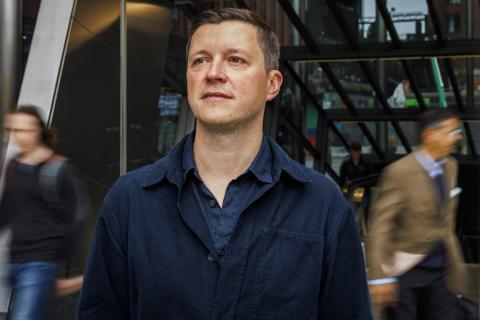
Robinson Bye Fellow Andres Sevtsuk paper on the first city-wide model mapping foot-traffic in NYC
Earlier this month Nature Cities and MIT News published Andres Sevtsuk's paper on spatial distribution of foot traffic in New York City.
"What gets counted, counts. Nowhere is this more evident than in the planning and design of our cities, where what and who is measured shapes what is planned, prioritized and funded. The amount of transportation infrastructure funding that states in the US receive from the Federal Highway Administration, for instance, has historically relied on how much residents of that state drive, as measured by vehicle miles traveled on principal state arterial routes (excluding interstate highways). This constitutes up to 35% weight in statutory federal funding allocation formulas1. Higher vehicle counts and more vehicle miles driven bring in higher Federal Highway Administration budget allocations.
Some municipal and state governments are increasingly acknowledging the unsustainable trajectory of automobile-centric growth2. Consequently, they have set forth ambitious mode-shift targets to promote non-car modes of transportation, such as walking, cycling and public transit3,4,5,6. According to the United Nations’ Intergovernmental Panel on Climate Change report, we are unlikely to meet our climate mitigation goals unless we can achieve a substantial shift to non-car modes4.
Among American cities, New York stands out in many ways. For example, more trips are made on foot (41%) than by car (28%)7, and its “80 × 50” climate action plan envisions that 80% of all trips will be made by non-car modes by 2050 (ref. 8). Despite pedestrians constituting the largest share of travelers in New York City (NYC), pedestrian trips are the least systematically measured and understood. The widely used American Community Survey journey-to-work data provide information only for commuting trips, which constitute less than one-third of all travel, thereby omitting the majority of walking trips9. Although recent municipal household travel surveys have begun to address this gap10, it is impractical to count pedestrians on every street of a city. There is, thus, a need for robust methods to extrapolate limited sample data to estimate city-wide walking patterns for pedestrian-oriented policy, planning and design. Existing models of pedestrian movement have typically been constrained to smaller districts11,12, relied on coarse input data such as street centerlines13 or used simplified routing assumptions14, limiting their applicability to describe pedestrian movement at the scale of a large city.
In this NYC Walks study, we assembled the first city-wide routable network of sidewalks, crosswalks and footpaths for NYC and developed a model to estimate the spatial distribution of foot traffic throughout that network. The model captures the spatial distribution of dominant walking trips during peak travel periods, which are calibrated on observed pedestrian counts to provide city-wide pedestrian volume estimates.
We examine the estimated distribution of foot traffic in different areas of the city and illustrate the model’s potential as a baseline for targeted infrastructure investments and hazard analyses through two illustrative use cases. First, we examine how estimated foot-traffic volumes on different streets can inform sidewalk classification and related public expenditure decisions. Second, we explore how fine-grained foot-traffic estimates can be used to understand exposure in pedestrian hazard analysis (such as exposure to extreme heat, air pollution and noise) using traffic crashes involving pedestrians in NYC as an example. Both these cases emphasize how quantifying and spatializing urban foot traffic can inform planning and policy-making to improve walking infrastructure, and contribute to a greater mode-shift to active mobility in cities. Pedestrian models can lay the groundwork for more inclusive, data-informed urban planning and policy, allowing people on foot to be counted the way only automobiles have been counted so far.
A variety of approaches have been developed to estimate foot-traffic volumes in built environments. Three modeling approaches can be broadly distinguished. First, sketch planning, factoring methods and direct demand models have been used to approximate pedestrian demand based on a comparative analysis of locations and their pedestrian activity levels. This typically involves regressing observed pedestrian counts against land-use mix, density, demographic, street type or other built-environment variables15,16,17, where individual trips are not modeled."
Andres Sevtsuk is a Bye Fellow at Robinson College, University of Cambridge (during sabbatical 2025/26)
Charles and Ann Spaulding Associate Professor of Urban Science and Planning
Director, City Form Lab
Head, City Design and Development Group
Department of Urban Studies and Planning
Massachusetts Institute of Technology