
Harassment, Sexual Misconduct, & Violence
Your safety and wellbeing are the College’s top priority. Our work includes providing an environment that ensures you can be free to study, work, and live without fear of harassment, sexual misconduct, or violence.
If you have experienced any form of harassment, sexual misconduct, or violence, there are many avenues of support available to you and options for reporting if you choose to do so.
See this page for an overview of everything students need to know about how the University prevents and responds to harassment and sexual misconduct.
- If you or someone else feel at risk right now and/or if you are injured then you can call the emergency services on 999.
- You can also go to the Porter’s Lodge or contact them (01223 339100 or porters@robinson.cam.ac.uk) and they will be able to assist you. For incidents in University premises you can call the University Security Office on +44 (0)1223 767444.
- You can go to The Elms Sexual Assault Referral Centre (SARC), for confidential, compassionate healthcare & support. You can get a forensic medical examination where they can store evidence for you while you make your mind up about reporting. You can get in touch with the Porters, , the Robinson Discrimination, Harassment and Sexual Violence contact person (Lizzi Rawlinson-Mills), or a member of the Wellbeing Team for support with transport to the SARC.
The Elms Sexual Assault Referral Centre offers free, confidential healthcare and compassionate support to people of all ages who have experienced sexual assault, including rape. Visitors need an appointment before attending the SARC in person. Call 0330 223 0099 to make an appointment. They aim to see everyone within 24 hours of appointment requests.
If you need a taxi to the SARC, the College will support you. You can request a taxi with the Porters or ask a member of the Wellbeing Team for support. If you would like to request this discreetly, ask for a taxi to Huntingdon Hospital.
The SARC services include:
- Immediate over-the-phone rape and sexual assault support and signposting to specialist services
- In-person rape or sexual assault crisis support and healthcare including access to medicine
- Forensic medical examinations
- Holistic examinations and care for non-recent cases
- Collection and storage of forensic samples
- Referrals to specialist counselling and Independent Sexual Violence Advisors (ISVA) support
- Follow-up calls after an appointment
You will be offered these services based on your individual needs and you can choose to use as much or as little of the service as you wish. See more information here for what happens during an appointment and what support you can access.
Key messages for you, if you have experienced harassment, sexual misconduct, or violence:
-
It was not your fault.
-
You are not alone; you deserve to feel supported and believed.
-
You have a choice in what you do next and what is right for you.
-
You can get support from trusted friends and family and/or professional support.
-
Whether or not you report is your choice. If you choose to report, you can also do so anonymously and with support along the way.
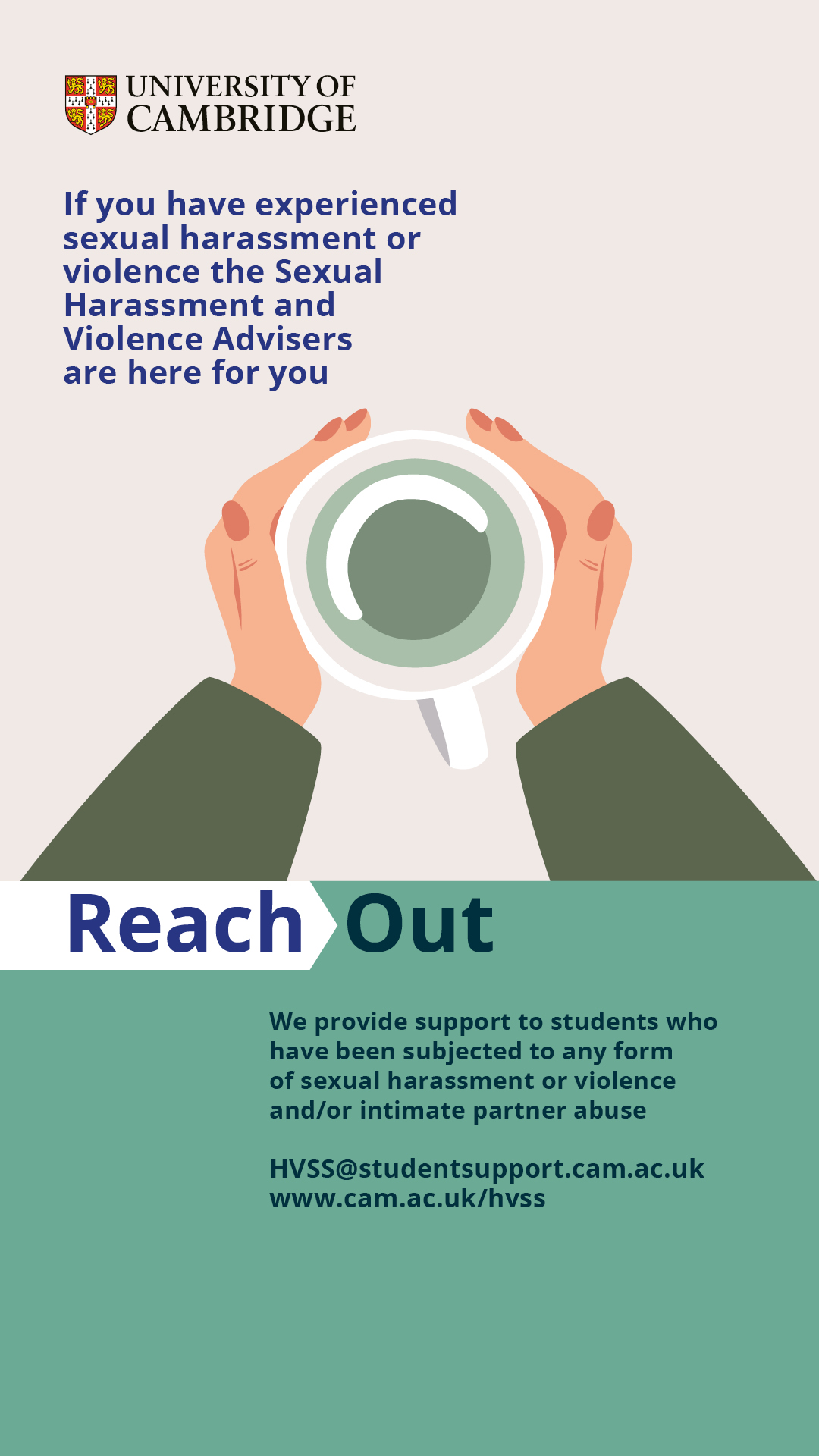
You can get support:
- In College from someone you feel comfortable with such as a member of the Wellbeing Team, the Robinson Discrimination, Harassment and Sexual Violence contact person (Lizzi Rawlinson-Mills), or your tutor.
- From the University Harassment and Violence Support Service (HVSS)
- The HVSS provides support to those who have experienced any form of sexual harassment, violence, or domestic abuse (including intimate partner abuse), as well as those impacted by religious or racial discrimination or violence. They can support you whether the incident happened in a university context or elsewhere, and whether it was recent or in the past. If you’re unsure about an experience and think it might involve sexual harassment, violence, domestic abuse, or religious or racial discrimination or violence, you are welcome to access the service and explore this with their advisors. Everyone frames their experiences differently. Please don’t worry if the language others use doesn’t match how you choose to describe your experience.
- Externally from an Independent Sexual Violence Advocate (ISVA) at Cambridge Rape Crisis Centre.
- Through the Hope & Healing group led by University Student Support. The group runs for 6 weeks during term-time and is open for students who have experienced sexual harassment, violence, and/or intimate partner violence.
- What previous group members have said:
- “Before this group I felt so alone in my experiences, but this group helped alleviate my feelings of shame, and provided me with a lovely community”.
- “Powerful, validating, and inspiring. I never felt as secure in myself and my own experiences as I did in this group.”
- Visit their webpage for more information, dates, and booking: https://www.studentsupport.cam.ac.uk/groups-and-workshops
- What previous group members have said:
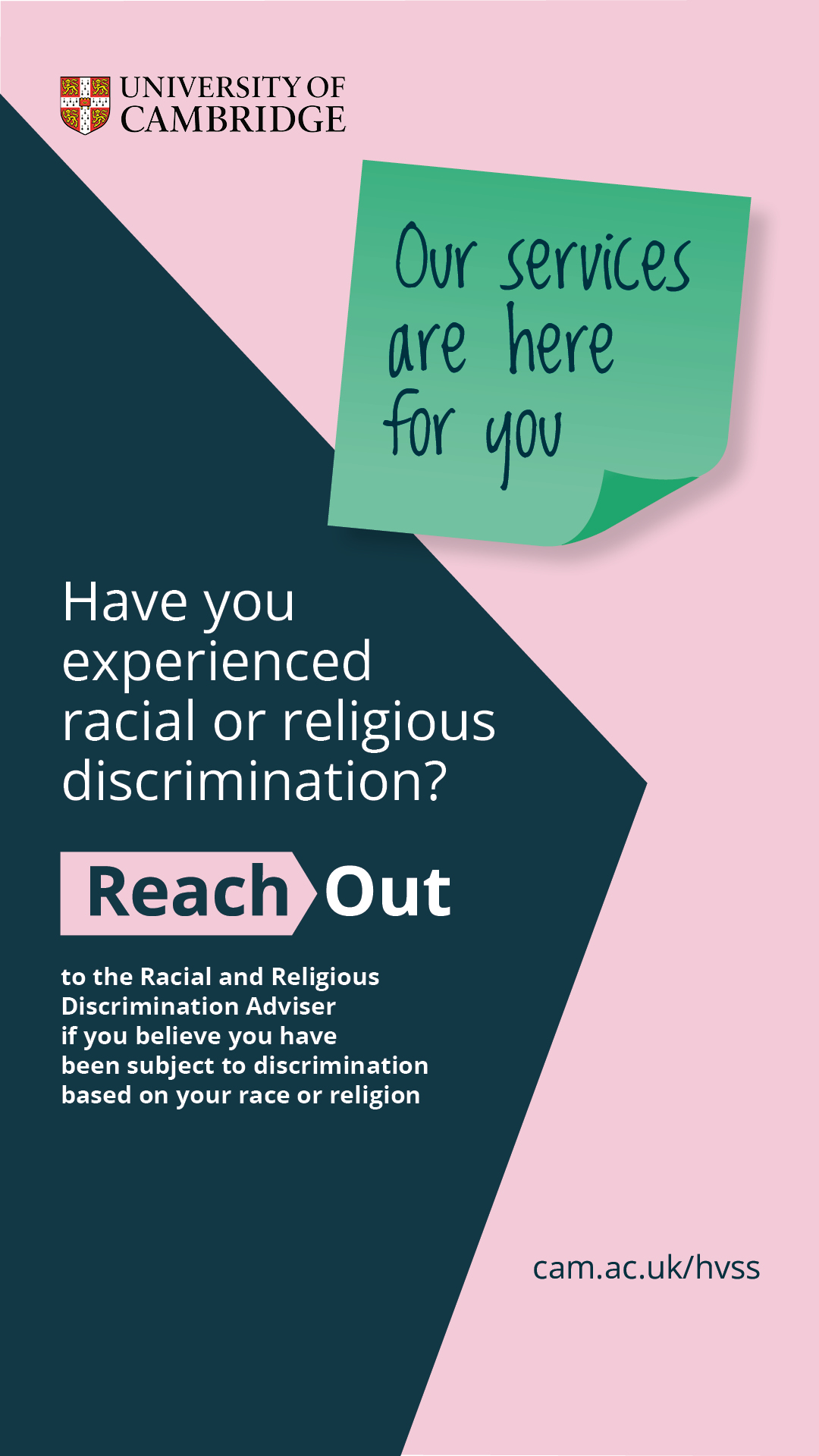
You can get support:
- In College from someone you feel comfortable with such as a member of the Wellbeing Team, the Robinson Discrimination, Harassment and Sexual Violence contact person (Lizzi Rawlinson-Mills), or your tutor.
- From the University Racial and Religious Discrimination Adviser through HVSS or see a counsellor through UCS. The Racial and Religious Discrimination Adviser (within HVSS) can provide the following:
- Emotional Support: A safe space to discuss your experience of religious or racial discrimination or violence. Help exploring the impacts and supporting you to manage these.
- Practical Support:
- Providing you with impartial information around your reporting options. We can advise you on how to raise your case formally either through a college procedure, with the University,or with the police.
- Support to manage any difficulties/issues that have arisen due to the incident/s.
- Supporting you through any reporting process you choose to engage with.
- Signposting and referring you to appropriate support services both within the University and externally.
- From external sources such as:
- Stop Hate UK: a confidential and independent helpline for anyone experiencing Hate Crime and discrimination.
- Boloh provides advice, and mental health and practical support to asylum seekers.
- Black Minds Matter connects black individuals and families with free professional mental health services.
- Muslim Youth Helpline provides faith and culturally sensitive support for young Muslims.
- Bayo lists organisations that work specifically with black young people, including mental health support.
- BBC Bitesize has expert advice on looking after your mental health if you have been affected by racism.
- Community Security Trust is a confidential and independent service for victims of antisemitic hatred, harassment or bias.
- TELL MAMA supports victims of anti-Muslim hate. It is a public service which also measures and monitors anti-Muslim incidents.
- The Equality and Human Rights Commission explains your rights under the Equality Act 2010, which covers protected characteristics like gender, race and sexuality.
You can report through the University through OSCCA or to the police. If a criminal investigation is being carried out by the police, University investigations will usually be paused. See the University page here for a more detailed overview on reporting options and processes.
- You can report the incident to the police if you choose to do so, including anonymously.
- You can report any incidents of sexual violence or harassment to the University; you don’t have to do this, but if you do, they can direct you to appropriate confidential support and help with any adjustments to your study.